
I remember Lucian Freud as a small child growing up in the decidedly un-mean streets of Kensington & Chelsea. As often with small children, you notice things but do not necessarily realise their importance until a lot later - did I know that one of my next-door neighbours was a famous artist? No. Did I know of him? Yes. But not with the awe, wonder or excitement that comes with living in proximity to one of the greatest artists of his generation. He was my childhood ‘Boo Radley’. True, he was no ‘boogey man’ but rather a figure that piqued curiosity whenever his name was mentioned in conversations between adults. Run-ins were scant and nerve-racking. I saw not an artist but an old man strolling down the road to the corner shop on weekends in a robe and slippers, and even then, I would be hiding behind an adult too busy being shy to know what was happening. And then I got older, fell in love with the art world and pursued a career in it. It was then that memories of ‘that famous artist down the road’ came back, and I was to discover exactly who that artist was. If only 5-year-old me understood.
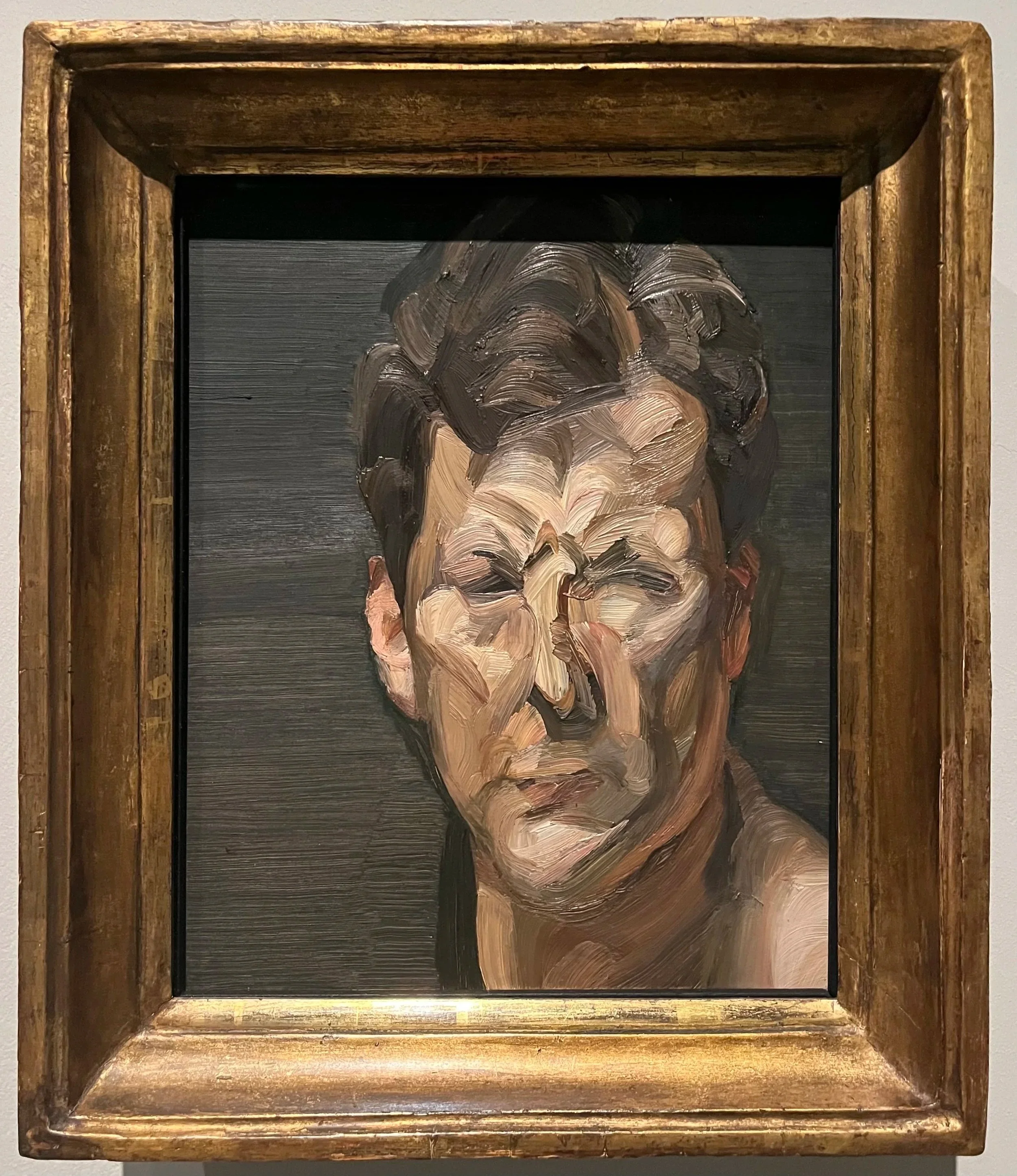
Self-Portrait (1963) Lucian Freud - Oil on canvas
David Dawson, Freud’s long-time studio assistant, still lives in the very house where Freud worked and is now director of the Lucian Freud Archives. This exhibition, ‘Drawing to Painting’, is his brainchild. A showcase of the career and development of Freud’s artistic practice across decades. From early childhood drawings to his last ever self-portrait, the exploration and evolution of a painter through to the very end.
When I first entered the space, I was immediately confronted by a blown-up photograph showing the studio in which he worked: The floors are bare and well-worn, faded and battered furniture is spread haphazardly around the room, and then there is the paint. Paint all over the walls: an extension of the painter’s palette; the studio is art itself. It is frozen in time in this photograph, but it was an ever-evolving space of creativity, thought, ideas and people. But we do not start in his London studio. We take a walk around the early works, which is where we start in the exhibition. It is the most charming thing of all, to see a child’s work, the innocent ramblings and exploration of a child drawing the world around them and the imagined: exotic birds of paradise, little boats on their way to who knows where. It is an endearing addition to the exhibition, and we are grateful to Freud’s mother, Lucie, for saving them.
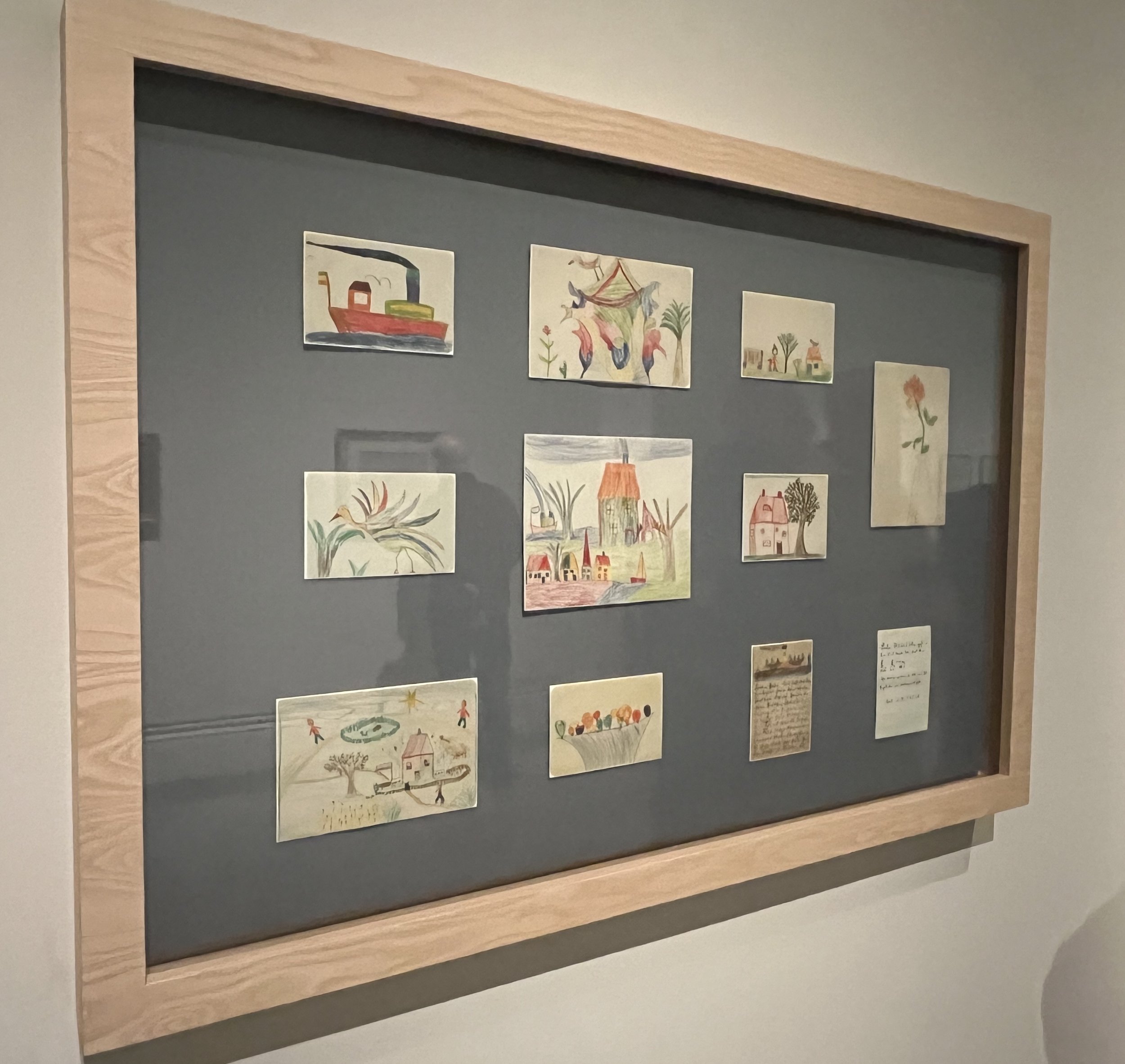
Drawings made by Lucian Freud as a child between the ages of 6 and 11
His early works are flat, two-dimensional works, but no less striking; the eyes are wide, and the background is neutral, the people carved into the canvas with precise surgical lines. Pulling out the outlines of people, their faces, their personalities. The eyes are the most poignant of these early works from the 1940s. Girl in a Dark Jacket (1947) is a prime example. They are cat-like, bulging, staring straight into your soul. The finite detail of her hair, the carefully constructed waves, with the subtle hint of frizz, are as though the sitter is on guard, ready to pounce. It was one of the standout pieces of the show, and when you compare it to some of his later studies and paintings, it is a testament to how far his practice developed over time.
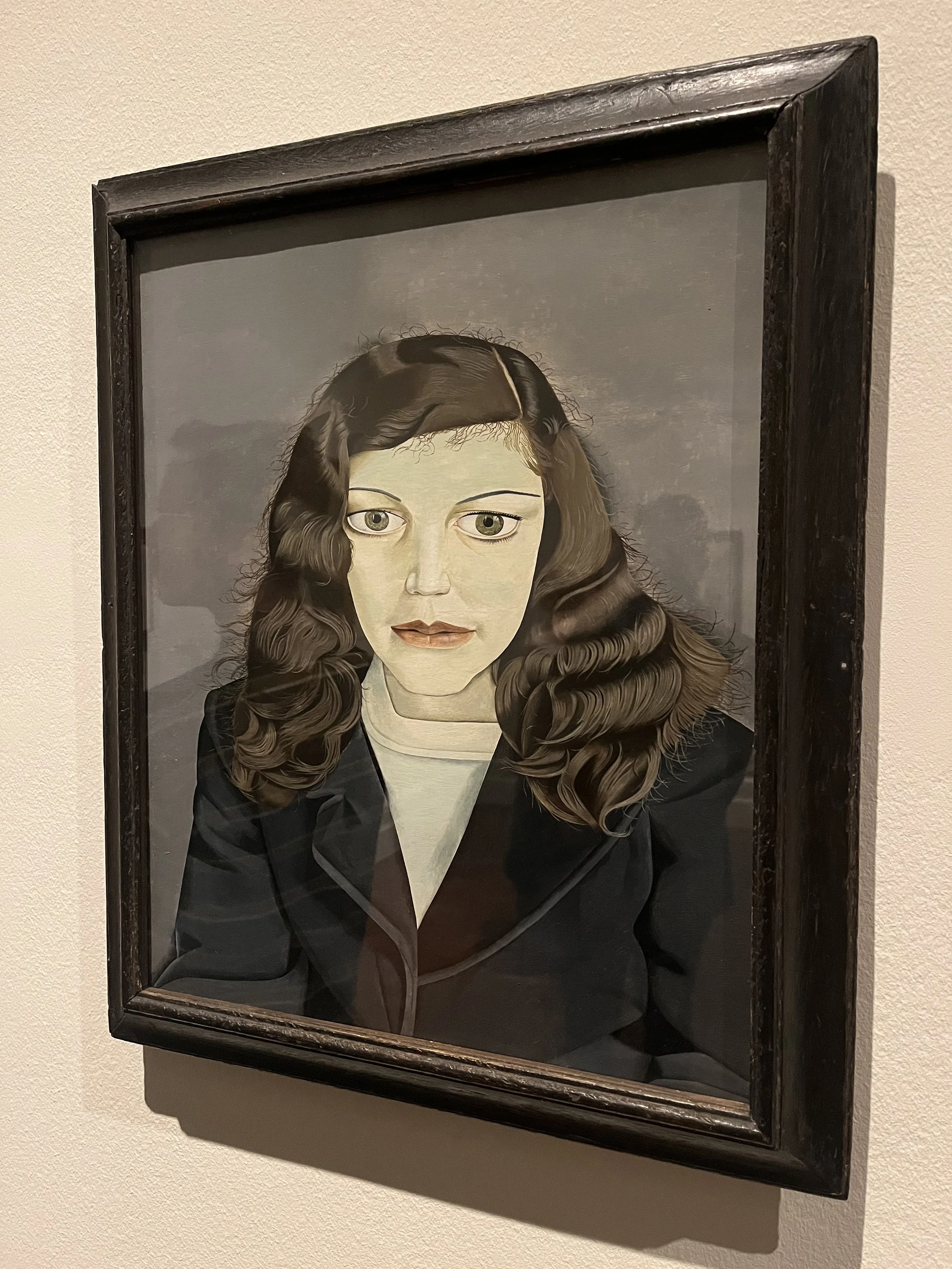
Girl in Dark Jacket (1947), Lucian Freud - Oil on Panel
Meandering through the exhibition, I noticed one thing in particular: Lucian Freud loved people. Out of all the subject matters he toyed with and explored, it was people he loved to paint best. While I loved the linocut prints and small paintings of thistles, chickens and monkeys, it was in the people, his sitters, where he flexed his artistic muscles. Freud famously collaborated with performance artist and Queer icon Leigh Bowery, which produced several intimate and vulnerable works. Are they Freud’s best? It’s hard to say, the works are so small, and yet unlike anything else that is in on show. It becomes less about the human form, Leigh on a Green Sofa (1993), we see a moment where Bowery is resting, unposed and unguarded. The shimmering glamour of the performer is gone, just human flesh and muscle away from the bright lights of Soho. It is Bowery at his most exposed, his most vulnerable and yet, while small, the work is sublime. Their collaboration lasted right up until Bowery died of an AIDS-related illness in 1994 and was decisive in both artists’ creative practice. Bowery was a big personality, and while the work shown here in this exhibition is small and intimate, Freud was challenged to go bigger, larger and expand. There was so much of Bowery, not just as a physical person, but Bowery’s personality and approach to life. No canvas seemed big enough.
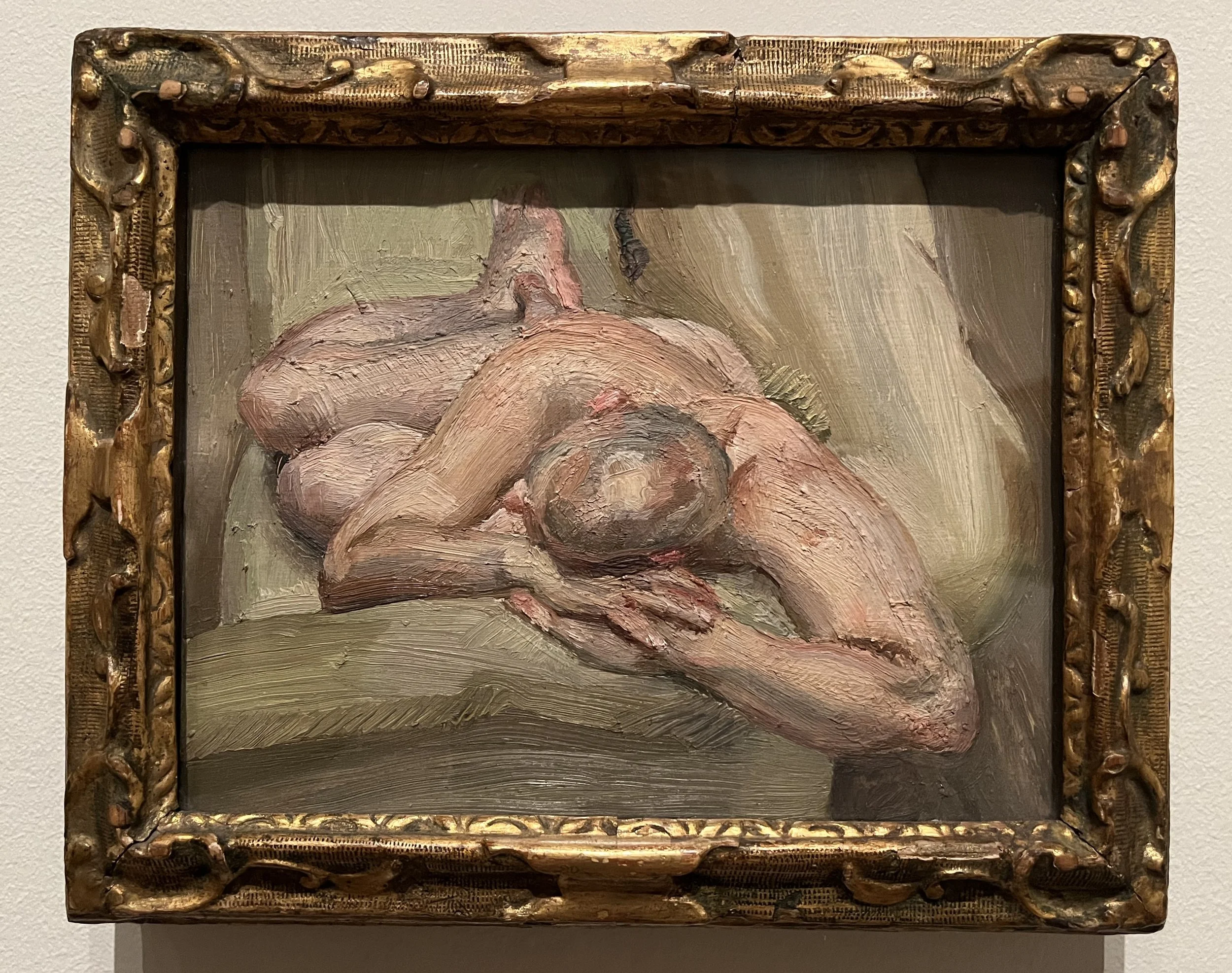
Leigh on a Green Sofa (1993) Lucian Freud - Oil on canvas
So the question is, why now? Why have a landmark exhibition on Lucian Freud? Why revisit Freud now? This is the first exhibition of his works at the National Portrait Gallery since 2012, shortly after he died, which was not too long ago. Some artists gain notoriety and fame once they are dead, while others live to see it. Freud lived to see it. Like most artists, his personal life saw a series of torrid love affairs and mistresses, sitters for his works being made to pose for extended periods of time in uncomfortable positions. By all accounts, a strong personality with even stronger artistic convictions, yet famously reclusive. From interviews with the people who knew him, when working, Freud was tense, a ball of energy hyperfixating on the subject matter in front of him. He is an artist blessed by a long career whose impact on the British and international art scene still resonates. His name is instantly recognisable - and not because of his famous grandfather. Perhaps there is still much to learn about Freud, as this exhibition proves; he was multifaceted. He was not an open book, and yet art historians and the public alike are trying to pry it open.
Ruminating on the exhibition, I feel like most exhibitions tend to romanticise certain artists, and while it is no longer true for Old Master painters and portraits, especially when it comes to their sitters, there is a romantic lens on to Freud. While it isn’t ‘rose-tinted’, the focus on his practice makes the audience look at Freud in a certain way. It’s an unusual standpoint as Freud was known to scrutinise his own subjects and look with a keen eye that strips you bare; why can we not do the same to the artist?
That being said, there were aspects of this exhibition I really enjoyed and was surprised by. I really liked the childhood pictures he drew - I think you’d have to have a heart of stone not to find those charming. I was also surprised to learn he did etchings. I was only familiar with his paintings and striking portraits of people; the etchings were fun to learn about, while very different from his paintings, there was a new depth to them that his paintings couldn’t draw out. Perhaps only being able to work with one colour of ink is what adds to the etching’s dimensions.
Would I recommend seeing this show? I went out of curiosity, and from how I remember Freud as a very small child. I went in with no expectations whatsoever. I was expecting to see a lot of portraits, which I did. I was not expecting to learn so much about him and how his practice evolved, which I am glad to have learned. I found I was really drawn to Freud’s relationships with the people who sat for him and how that played into his practice. There are clear merits to going to this show, and it has enough content and key works to warrant the exhibition price tag. If you are a fan of Freud, you’ll enjoy the show; if you are neither here nor there, if you go, you’ll learn something new about Lucian Freud.
Lucian Freud: Drawing into Painting is on show at the National Portrait Gallery, London, from the 12th of February to the 4th of May 2026.